European PKM Summit Report: An Impression of Day Two
Saturday 23 March 2024
Day 2 of PKM Summit starts with a hearty breakfast at the venue to prepare body and mind for another day of PKM knowledge, sharing experiences and connecting with people. Again, participants experience a luxury problem: which sessions to select from the superabundant program? Fortunately, there is no wrong choice, with a line-up like this.
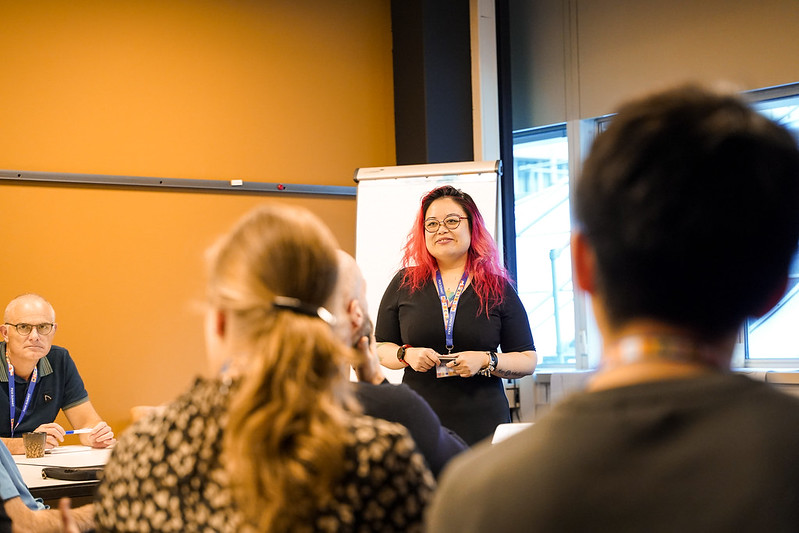
Doing It In Public: Observability for PKM
Nicole van der Hoeven’s YouTube channel on PKM and Obsidian gained 50.000 subscribers in only two years. She works as an ethical hacker for companies and sees great parallels between her daily work and PKM.
Companies hire her to find weaknesses in their systems and applications so that she can make them better. To be able to see what's happening within the system, the first thing that she does is setting up observability tools. ‘Sometimes just exposing those metrics makes it possible for the entire system as a whole to improve. Like when you want to change a habit. One really simple thing you can do is just put an X when you've done something. Now that it's there on the calendar, you don't want to see that streak broken. You want to keep doing it every day. Nothing really changed about you as a person, all you did was make it observable and yet that already has effects.’
The benefits of an observable PKM
So the first benefit of an observable PKM is accountability. Recently, Van der Hoeven announced that she’s writing a book on Doing It in Public. ‘People hold me to that and when they meet me, they ask "How's the book going?” "Great question!” "Yes, I should be writing that book!” There is accountability in saying "Hey, I'm doing this thing, please ask me about it, please make sure that I do it and let's all do it together”. At nicole.to/dip, she lets everyone read along.
Observability also provides her with instant feedback. ‘I’m writing this book in public. I am putting out chapters as I write them. It’s messy! I don’t know what I'm doing, I've never written a book before, but a lot of people have.’ So when she’s putting something out there she’s getting feedback.
There's also the benefit of visibility. Publishing notes online makes it clear to others what your favorite topics are. ‘I haven't had to apply for a job in the last decade because people find me, they see me because I'm out there.’
Observability additionally provides clarity. ‘It’s one thing to say you know a topic but if you have to actually explain it suddenly you find out that you didn't really know it very well after all and when you write something down.’
Lastly, observability provides scalability. ‘If I thought that everything that I had to put out had to be absolutely perfect and absolutely polished, I would never do any of it. I like to think of notes as something that can change.’
How to make your PKM observable?
>> Read the full article on Nicole van der Hoeven’s talk.
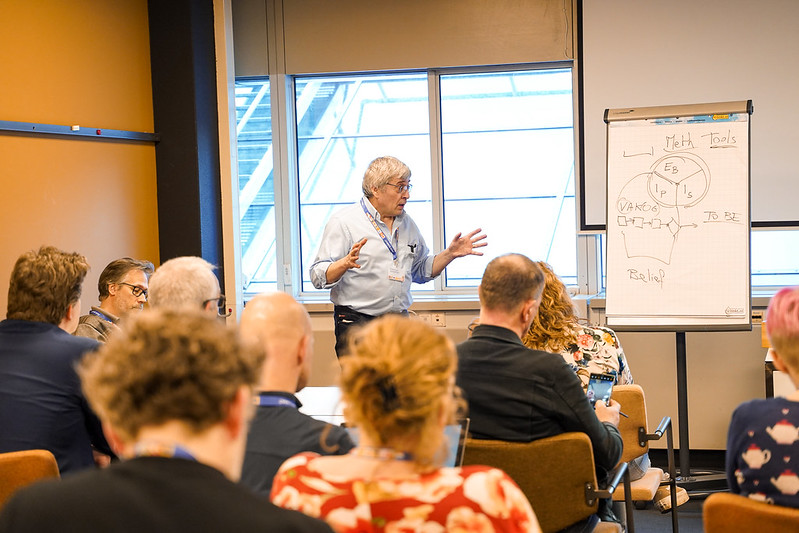
With all knowledge above in your pocket, how about some ethical hacking of your own brain? Are your thoughts observable to yourself and how do you influence your own brain? The session Decoding Thought gave intriguing insights.
Decoding Thought - Christian Vanhenten
@christian@aikicom.eu is a trainer, coach and designer of AïkiCom. This pragmatic and original approach to communication, emotional management, stress and conflict management, inspired by aikido. Vanhenten was an engineer specializing in process modeling and change management, and held senior management positions as a military administrator at Defense.
How is our brain originally programmed? Vanhenten enlightens his PKM audience about neurolinguistic modelling - the main process for your brain & personality. This is the elemental theory wherefrom the more popular mental technique emerged: Neuro Linguistic Programming (NLP). Vanhenten even warns the audience: ‘Beware that quite a few NLP practitioners do not even know the modelling theory’. He claims that this is the case with a lot of PKM too. ‘First you learn about the tools, than the methods, yet most users are not aware of the modelling behind the theory. Why do some students take up on a theory so easily and others do not? What is modelling exactly?’, starts Vanhenten his lecture.
‘Be careful using the verb To Be’
Decode the way you do
On a classic flip over Vanhenten draws a circle, divided in three equal parts: External Behaviour + Internal State + Internal Process. ‘The human brain is always influenced by these three fundamentals. It is a mind and body process: feeling, thinking & gut feeling. It works together in a systemic way’. He urges the audience to sink a bit lower in their chairs, shoulders depressingly forward, head hanging tiredly. ‘Now, try to feel joy’, is the simple assignment. The audience experiences how difficult it is, even when a lot of people are happy to be here at the PKM summit.
‘The good news: you can work on every element to influence the other elements’. Vanhenten gives a few examples of the influence ‘reframing’ can have. ‘We can decode the way you do, that is where the real power is!’, smiles Vanhenten enthusiastic: ‘Be careful with using the verb ‘To Be’ like in the excuse that is just who I am, as it becomes true. If you reframe it towards that is just how I do, it becomes an option for your mind to change behaviour & mind’.
Principle of resonance
Another visualisation practice Vanhenten includes in the lecture, is the state of mind in which you enter a bookstore. He lets the audience experience the difference of a set mindset and an open mindset in which you can let yourself be surprised. ‘It is a more childlike mindset in which serendipity can happen. For some people this comes more naturally than for others, nevertheless it can be trained and it is a method to find your way in the abundance of information’. He emphasizes the principle of resonance with another assignment. ‘You have been looking at me now for a while, in this room. Now take a look behind you to the back of the room and after that return to me again. Your perspective of this view and of the room has changed, even though your visual to the front of the room is the same. You experience the surroundings in a more wider perspective now.’
Now, with all theory and modelling in mind, Vanhenten treats the audience on several cases how reframing can help you and can improve your PKM as well.
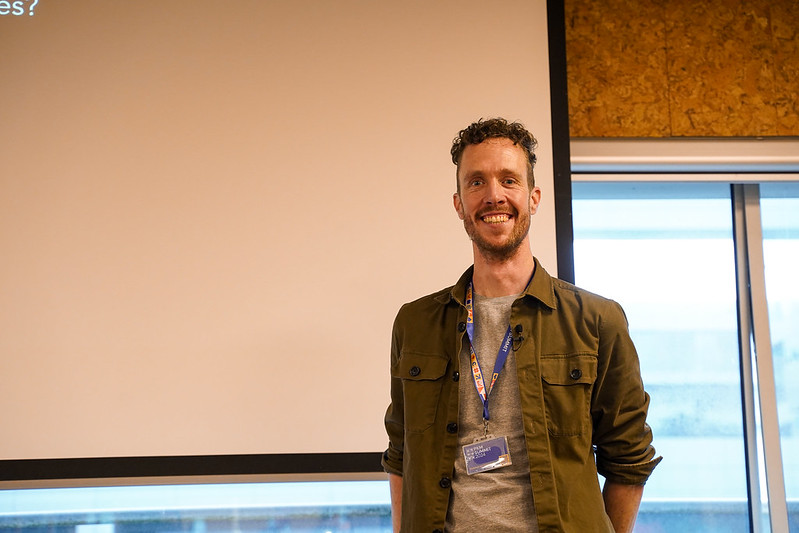
Reframing your mind will impact your future, but there will always be external influences as well. In the next session, Peter Joosten shows us what the future might look like and how PKM has a great value in it.
Learning organisations: PKM as the missing link - Peter Joosten
As a futurist and future researcher, @Peter Joosten helps organizations and teams to better prepare themselves for the future. t
‘That thing that made you weird as a kid, could make you great as an adult - if you don’t lose it. This excellent advise for living comes from Kevin Kelly and I cannot stress enough how essential this is for learning organisations,’ starts Peter Joosten his talk. His own ‘weird thing as a kid,’ he confides with his PKM audience, is that he was his brothers personal consultant/researcher. ‘My brother would have a question - mind you, this was before Evernote, Notion or even the internet existed - and I would go to the library to find the answer’. To be a curious and learning mind (as a person or a organisation) is very useful. Adam Grant states it wisely in his book Think Again. ‘Organisations with a learning culture innovate faster and make fewer mistakes’.
Joosten dives into the theory and takes his audience down the road of acronyms that describe the uncertain and complex future we are facing - ‘the current state of affairs at the moment’. VUCA: Volatile, Uncertain, Complex, Ambiguous. BANI: Brittle, Anxious, Non-linear, and Incomprehensible. RUPT: Rapid, Unpredictable, Paradoxical, Tangled. TUNA: Turbulent, Uncertain, Novel, Ambiguous. It emphasis the need for learning organisations to face these uncertainties.
Why do organisations fail at having a learning culture?
Joosten shows how he as Future Researcher works with the Framing Foresight model, which can help to get more grip on the future we are heading to: Framing, Scanning, Visioning, Planning & Probing and Acting.
It is clear to the audience that a learning culture in an organisation has benefits in this fast changing world, for both the organisation and its co-workers. Yet, there are more organisations that fail at this, than succeed. ‘So let’s see which disciplines are vital in a learning organisation: personal mastery, shared vision, systems thinking, mental models and team learning,’ shows Joosten. ‘Encourage dialogue and collaboration to create a shared vision, use system thinking to address complex challenges effectively, create team learning in open dialogue and challenge mental models, by fostering new ideas and perspectives. And, last but not least, make sure there is Personal Mastery in the organisation to enhance capabilities and focus energies’.
‘The challenges vary from hierarchy, willingness to change, money and lack of time.’
Ego as the biggest obstacle
With all theory in mind, Joosten lets the audience focus on how PKM can be used to help (become) a learning organisation. ‘What are challenges for organisations to improve their learning capabilities and how can PKM help?’ In small workshop groups participants share knowledge, state the obvious and come with new insights and affirmative guidelines. The challenges vary from hierarchy, willingness to change, money and lack of time. But one of the biggest challenges in becoming a (more) learning organisation pops up in all groups: ego. ‘There are a lot of people who fear for their knowledge position within the company, sharing knowledge and letting go of the top down structure, hurts their ego,’ explains one of the participants.
No surprise with this audience, but everybody is very confident that PKM can help in becoming a more learning organisation. According to the workshop members it supports: transparency, open sessions, networking, learning styles & methods, reflection and meeting culture.
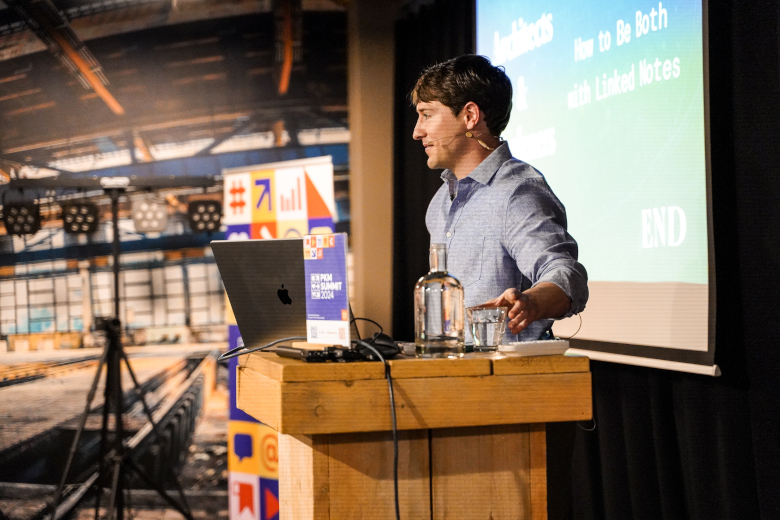
On the first Summit day Anne-Laure Le Cunff talked about the architect and gardener way of working in your PKM system. Nick Milo too is a fan of the architect and gardener metaphor. In his session he showed how to make them work together to your advantage when you’re stuck in your creative process.
The Architect and the Gardener: How to Be Both With Linked Notes - Nick Milo
@Nick Milo spent the last 15 years using digital notes to create and grow a fitness boxing into an international company, produce two independent feature films and to become a TV and film editor. He is the founder of Linkingyourthinking.com.
‘There are two types of writers. Architects and gardeners. The architects plan everything ahead of time. The gardeners dig a hole, drop a seed, and water it.’ - writer George R. R. Martin
The framework of architects and gardeners can apply to all sorts of problem-solving creative efforts, Milo says. ‘Architects are top-down thinkers that prioritize order and structure. Gardeners are bottom-up thinkers that prioritize chaos and curiosity.’ And when we're stuck, we can just move between the two modes of thinking. ‘Sometimes we spend a lot of time top-down thinking. Other times we're in curiosity mode and then we get a little overwhelmed by the rabbit hole we’re in. So what do we do? We go back to architect mode so we can make sense of that stuff.’
The downside of architect and gardener tendencies
When taken too far, your tendency for top-down thinking can lead to stifling, rigid thinking. You can become paralyzed when you don't have enough structure. This can manifest in coming across as needy and overburdening to others. Whereas the tendency for bottom-up thinking can lead to a chronic sense of anxiety around trying to find things. A tendency for unhealthy bottom-up thinking is to chronically collect new and exciting information, never to touch it again.’
Convergent, divergent and emergent thinking
‘When architects are operating in healthy convergent thinking, they enjoy seeing the big picture. They prefer knowing more about a subject or situation before they act. They like categorizing, and use the big picture to further their decision-making and overall sense-making. The question is, can you go from that convergent thinking but be loose enough to allow for these emergent ideas to form, these insights from your work?
Gardeners when they're healthy, they are divergent. They're capable of operating without having a high-level picture. They're able to work with limited information and follow the trail of enthusiasm, clues, and connections. They generate a lot of thoughts. Can they go from divergent thinking to emergent thinking?’
How folders and linking affect our thinking
Folders help us organize, but not to think, says Milo. ‘Documents were required to live in a single place, and that was good for files, but it's not so good for ideas or the development of ideas. Folders then force architecting. And that's great, if that's what you need at that time. But when architect is already your tendency that you go towards, you now have folders that are doubling down on that tendency, and you get stuck. There's no time for that emergent energy, that bottom-up energy that might be the thing that gets us to the other side.’
‘I'm a huge advocate to not just take notes, but to make notes.’
Imagine you have an idea. Where do you put it, in what folder exclusively? ‘You don’t know the answer and you spend your entire day redesigning your entire PKM system, because this time it's going to be perfect.’ Whereas with using links, we can create a network that grows over time. ‘We can grow ideas in richness. We can foster insights and innovations. We grow a forest of ideas, of notes.’
>> Read the full article on Nick Milo’s talk.
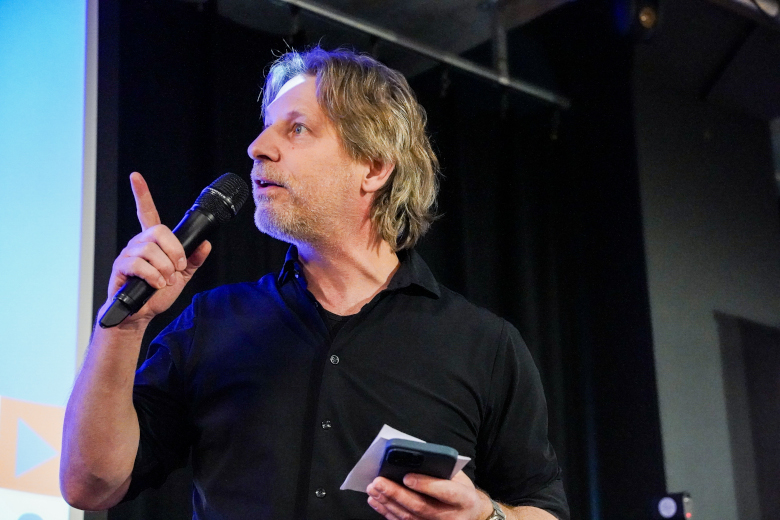
The final session of these energetic two days was presented by PKM Summit co-founder Martijn Aslander himself.
A 15 year journey in personal knowledge - Martijn Aslander
As a speaker, author and connector @Martijn Aslander is known for his ability to cause paradigm shifts in thinking. He was standing at the cradle of the Dutch PKM movement and co-founded digitalfitness.com and the Dutch Maand van de Digitale Fitheid (Month of Digital Fitness).
With a lot of energy and enthusiasm, Aslander shows his personal (analog) stats from 1999. He gets a respectful ‘wow’ from the audience in return, as well as surprised laughs when he shows pictures of an ordinary hotel room in extraordinary use. The complete bed and floor are covered with papers, magazines, newspapers and notes in what appears to be, no order. ‘This is the phase when I process information’, explains Aslander, ‘You need to get to the source that resonates with you. I believe that the biggest part of our brain is still in the hunters/gatherers mode. You will have to put things where they are logic to you. That is what I am doing here, our brains are trained for visual aspects and I am creating visual landmarks for my brain’.
Fascinated by data, smart with information
Aslander explains the processes our prefrontal cortex has to do to get the information in: read, code and decode. He tells about his daily sessions of thirty minutes to order his notes in his PKM system. Aslander is very fond of software tools and loves to watch a demo, learn, get inspired and benefit from everything that comes on his path. All information he gathers and processes in his PKM find its way back into the world through podcasts, blogs, talks and books. ‘I even have it tattooed on my arms: ready to serve & born to create’, shows Aslander. His fascination with data helped him order and combine all his stats and his willingness to be smart with information. And technologies make it easier to compare and store. He plays with both analog and digital systems.
Aslander demonstrates his beloved paper bullet journals and is very aware of the biggest downside: ‘There is no CTRL-F in this’. Yet, he loves the structure of pen & paper and found a way to combine analog with hyperlinks to digital pages in his PKM. ‘My kids have their own page in my PKM and that is already in Obsidian,’ ends Aslander.
2025: PKM Summits in Utrecht, USA and New Zealand
At the end of two days of exchanging knowledge and experience the audience is excited to hear that the next European Summit is already scheduled for March 2025. On top of that founders Aslander and De Vries announce that plans have surfaced to organise PKM Summits in the USA and New Zealand in 2025.
Apart from gathering new insights the PKM Summit facilitated the opportunity to meet other pioneers in this subject field. ‘I loved the topics and it’s great to see that there are many weird people like myself,’ says participant and speaker Zsolt Viczián.
De Vries: ’I’ve been hearing this a lot, “Wow, I'm not the only idiot in the room”.
Nicole van der Hoeven adds: ‘You get me in a way that even my husband doesn't because he was like, “Wait, you're making videos about taking notes? Now you're going to a weekend with other people who take notes with you?” I'm like, yes, I swear, that's what it is. And I don't have to explain that to anyone.’
Visitor Dorothea catches the overall excitement of the two Summit days by saying, ‘If this conference were held on a cruise ship and we'd get stuck in front of the harbor, not being let in, well, as long as there's some food, would this be a serious problem to anyone to stay a week longer?’
Participant and speaker Evelyn Pacitti adds: ‘New books, new ideas, terms for things that I didn't know there was a word for, and there were three words for it! I have gazillions of rabbit holes and new connections that I made. Both in knowledge and in people. So, thanks!’
>>> Click here for an impression of the first summit day.
Report: @Cath Spiceminds and @Cathelijne Esser
Photo’s: @Jeroen Koster