PKM Summit report: An Impression of Day One
Friday 22 March 2024
As humanity we have always sought ways to capture, process and enrich information, to then share or publish our insights, knowledge and wisdom. Nowadays we call this process personal knowledge management (PKM). Today's technological possibilities makes PKM much easier and even more potent and enjoyable. Reason why @Lykle de Vries and @Martijn Aslander gathered PKM experts from all over the world for a two-day summit in Utrecht, in March 2024. In this article we share an impression of the first summit day.
In over 40 lectures, workshops and Q&A’s, PKM-pioneers shared their knowledge and experience on methods, applications and tools. Two days filled with enthusiasm for the subject, the possibilities, and perspectives.
Experts learn from amateurs too
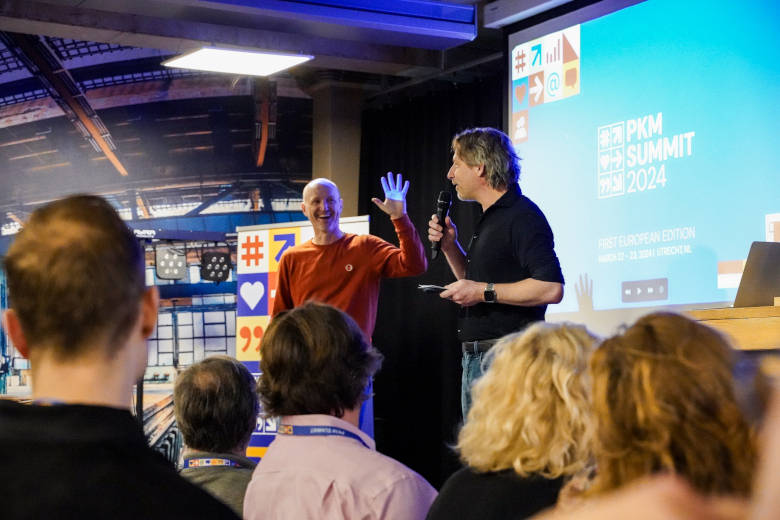
Not only geeks were excited to exchange with 150 PKM enthusiasts two days long. The Summit attracted many people for whom PKM was still quite new. Even founders Lykle De Vries and Martijn Aslander do not consider themselves PKM-experts. If only because the subject is constantly evolving and there is so much to learn. ‘I dabble, I stumble, I try stuff,’ De Vries says, and that pretty much sums up how most people experience PKM. ‘So if there's a question in your mind, this is the place to shout it out, there's so many people around that have experience. Even if you think “maybe I'm not somebody that has the experience to talk about it”, yes, you do. You have your own ways of working that might be helpful to others.’
Aslander adds, ‘we wanted to have a community event. So the aim here is to meet, greet, learn, show, tell, ask. We have been running small PKM meetups every two months in this very room at Seats2Meet. And most of the time, the experts learn the most from the amateurs. Because everybody has a different mind.’
Nonetheless, all of our different minds have similarities too and that is why the PKM session with Anne-Laure Le Cunff is a perfect start to how different brains function in different PKM systems.
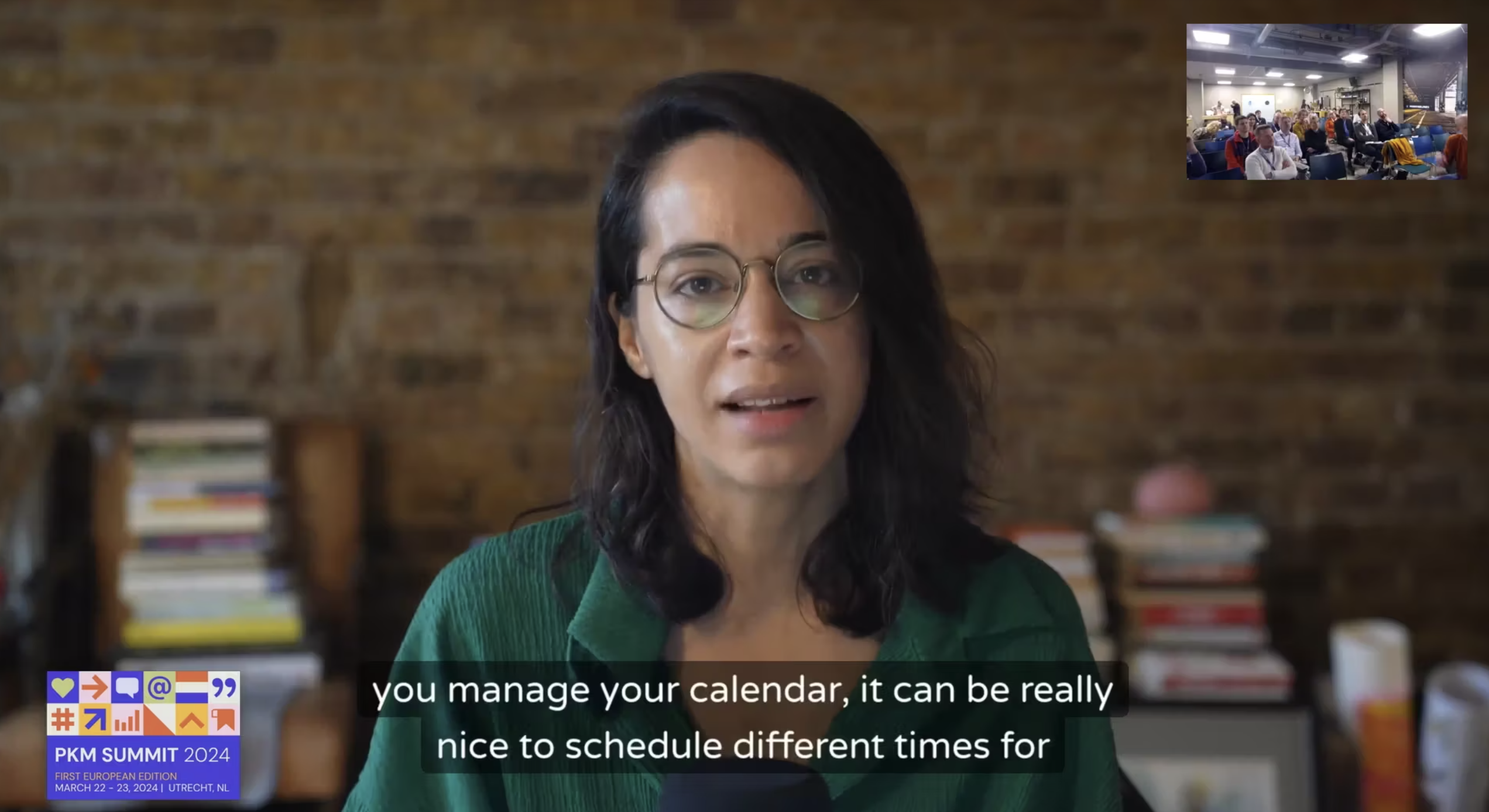
Mind Gardening: A Flexible PKM System for Emergent Creativity - Anne-Laure Le Cunff
@Anne-Laure Le Cunff is neuroscientist, educator, author and founder of the mindful productivity school Ness Labs. She worked at Google and is a well-known start-up founder.
After her introduction, her talks starts with a reminder of the covid years and how so many people started gardening. Literally planting seeds for the first time in their lives. Gardening became a lifeline for many people in an unexpected, challenging and exhausting period in life. ‘It was the moment where I got inspired to see the mind as a garden too. I saw a lot of parallels: we plant seeds of ideas, grow branches, connect ideas together and than you harvest the produce of your thinking’, shows Le Cunff the metaphor.
The way gardeners think
She read an interview with author G.R.R. Martin, who talked about two types of writers: the architects and the gardeners. The ones who plan in advance and know how the result will look like vs. the ones who have a much more emergent approach to their creativity. Taking all of this together, Le Cunff created a typology of note-taking styles in 2020 with the architect, the gardener and the librarian as types. ‘I added the third type, as I realised that some people I know, were not fitting in the type of architect, nor gardener. They just want a place they trust & where they can store all of their knowledge: the librarian.’ She points out that this talk is not to let the audience ‘become gardeners’, nevertheless for sharing some of the way gardeners think in their PKM systems, which could be useful for theirs.
Focus mode and diffuse mode
Le Cunff explains that the brain has two modes of thinking: the focused mode and the diffuse mode. Stuck in focus mode, you cannot come up with an idea of connection, but when you let your mind wander a bit (by taking a shower, going for a walk) your mind pops up with the solution, idea or connection. ‘You are allowing it to happen in the background and that is exactly how amazing our brain is in connecting ideas together. Trust your default mode network (more). Just like a gardener will trust that nature will do its work’.
Linear thinking vs. network thinking
She talks about linear and network thinking. The first is really good for known problem spaces where efficiency is the goal, but rarely leads to novel connections between ideas. 'When you want to generate new ideas, connect ideas together and create non obvious insights, you’ll need the powerful network thinking. In which you do not go from A, to B, to C, but see the network between them. B and C may influence A. Connecting B and C may improve A'. She remarks that network thinking has its own drawback, like any mode of thinking has: ‘It is slower and a lot more resource intensive. It’s a bit of a heavy tool that you do not want to use for absolutely everything.’
>> Read the full article on Anne-Laure Le Cunff’s talk.
Surprise sessions
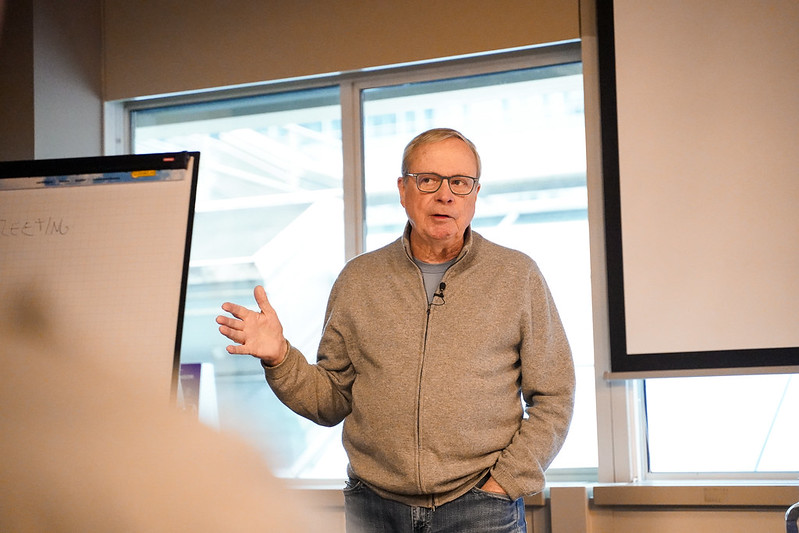
The summit program included some surprise sessions too. One of them was David Allen, founder of the Getting Things Done Method. His unannounced visit immediately created a buzz among the participants.
‘It was such a great surprise when I saw David Allen walk into the room there!’ visitor Mascha says. ‘I read his book for the first time in 2008 and it was life-changing for me, as it has been for so many people. I embraced the Getting Things Done method right away and tried to learn all about it. After watching so many webinars and other videos, and listening to so many podcasts from him and the other coaches, it was really great to finally see him in real life. I just couldn’t believe it that I was sitting right there in that session.’
Getting Things Done With Teams - A Q&A with David Allen
In his session David Allen talked about his latest book Team. Getting Things Done With Others and was in the mood for an amusing Q&A. Team will be released May 26th, 2024. Followed by the Dutch translation in October 2024.
’It's taken two years to write the new book,’ he says. He and co-author Edward Lamont wrote it because he noticed a big gap. ‘Once people get Getting Things Done, which was focused on individual best practices for productivity, they have to deal with people who don’t get this yet. They say “It would make life and work so much easier if people around me got these same best practices”. So, Ed and I have now written the manual. Anybody who's trying to get stuff done with other people are essentially a team. It's basically the three primary models out of Getting Things Done. The five stages of how you get control, the six horizons of focus to get priority, and the natural planning model.’
Q: Not many people can see you in real life, so they have to read your book. Did you think of other ways to deliver your advice and your methods to people that are not good at reading?
Allen: ‘No. There's an audio version of the book. But you actually need to engage with the material before you really get it. You can understand it intellectually very easy. It's pretty common sense stuff. Like you can understand how to play football. Then it comes to the doing. You can have individual great players, but if they don't know how to work together, the team sucks. How we work with each other is not something we're born doing or born knowing.
In the new book we just work on the mechanics of how a team works together, so that the little stuff doesn't get in the way of the big stuff. There's a lot of big stuff your team needs to be focused on. And if the little stuff sucks, you can't do it. We just wrote the fix of the little stuff. How many tools do you bring into a meeting digitally? Do you bring in your phone, your computer, your iPad into a meeting? Why are you in the meeting if you're not going to be focused on what you're doing? We've got two whole chapters on team standards. What are the standards about how a team decides it wants to work together? What are the rules of engagement about that?’
Q: Is it mostly your own experience in working with teams? Or are you also looking at other fields, academics?
Allen: ‘I have no formal, traditional education in business psychology or time management. All of mine is just street smarts and my own experience. Thousands of hours I've spent with senior people and teams working with this material and trying to figure out how to use it, and honing it so that it got as simple as we could and usable as it could. But that's pretty much it.
We have a chapter in the book called The New Work, which started with Deming and Kanban and Six Sigma and Scrum and Agile. All that has to do with how do we manage efficiently the external workflow? But pretty much that's only been useful for software or manufacturing or whatever where you had a very simple flow of the work process itself. But go to marketing, go to PR. How do you create a standard of workflow in those knowledge work kind of things? You don't really. You could say, “here are the things that they still need to focus on and ways that they can focus on it”. But it's going to be out beyond agile.’
>> Read the full Q&A with David Allen.
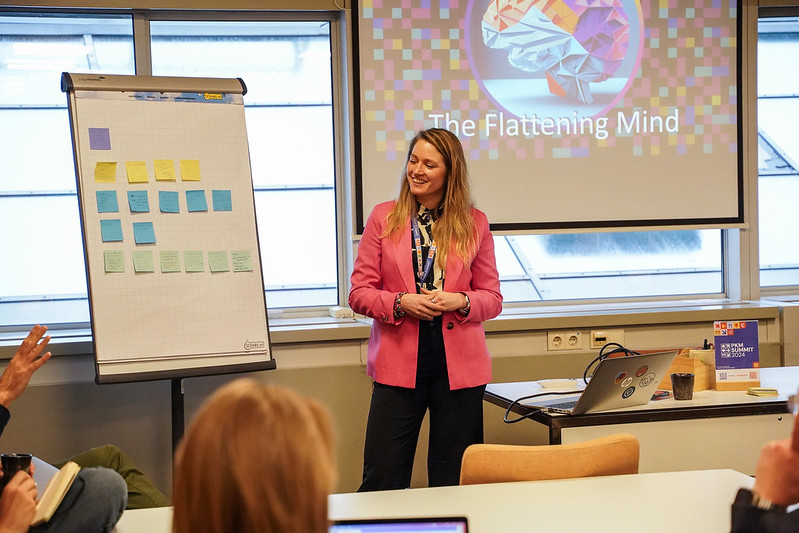
After focussing with Allen on teams and PKM, it is time to get personal again. Marieke van Vliet shows us to be aware of all things around you, influencing your mind and your PKM, in her session about the flattening mind.
Reviving the Flattening Mind - Marieke van Vliet
Dr. @Marieke van Vliet researches Ethical Technology and helps knowledge workers build a Brain Palace.
‘Did your way of making notes change over the years?’ queries Marieke van Vliet her PKM audience at the start of her lecture about Reviving the Flattening Mind. Instant replies tell she is right on target.
‘Absolutely! I am adding sparkles nowadays and I don not keep the rest’, confirms one person. ‘I started very strict and structured, now my daily notes are more flexible and chaotic’, adds another. ‘My chaotic mind finds its own structure now’ and ‘My notes are more organic and now it is growing’, share other members from the audience.
Van Vliet: ‘It is very personal which way of note taking comes natural for you and how it develops. Nevertheless, be aware: whether you work with an emergent or iterative system, have an experimental mind, are a search bar-worker or have a general chaotic mind with a random ‘system’, technology influences us all’.
Learned Helplessness
The information overload our brain has to process each day, forces us in a spiral of more superficiality. We are becoming less able to really dive into the (bits of) ocean or information. ‘Technology is constructed to give ‘comfort’, making it as easy as possible to buy or click. Even when buying or clicking might not be the best option for us. Our online and offline bubbles of information are repeating specific information, which our ‘biased confirmation’-brain absorbs. Combine this with an ‘everything overload’ and it results in Learned Helplessness,’ concludes Van Vliet.
‘Your 2-minute toothbrush session feels longer than it used to, right?’
‘To whom does “I used to be able to…get sucked into a book / be able to get lost/feel in my body when I needed a break” not resonate? Nowadays, the human brain can focus for only 40 seconds. This explains why your 2-minute toothbrush session feels longer than it used to”, explains Van Vliet. Fortunately it is not all dramatic, nor all lost. Nevertheless, it is important to realise that we are spiraling down and to question the egg/chicken situation: are we creating series and shorter movies because of our shrinking attention span, or is our shrinking attention span due to all the snippets of media we are consuming? Van Vliet shows the different aspects of the google effect, device mindset, exposure to ‘more of the same’, the way we manage our lives in a business way and explains how she trained herself to be less distracted with the use of apps like freewrite.com.
>> Read the full article on Marieke van Vliet’s talk.
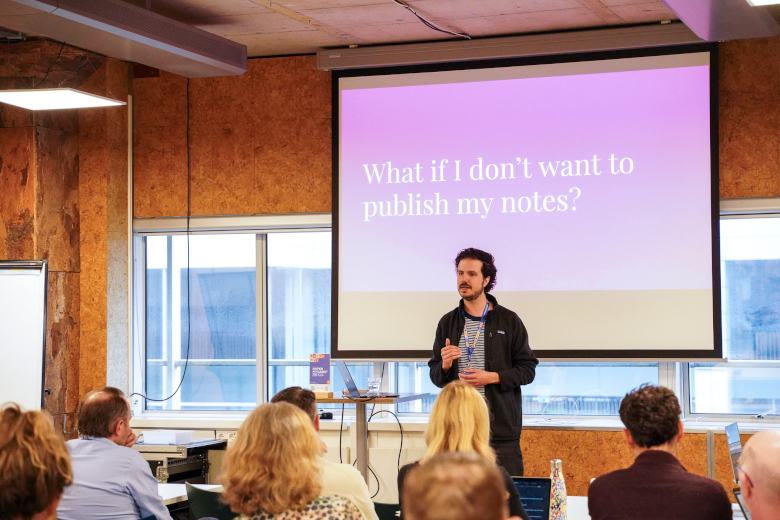
Another way of approaching your notes as a valuable source, is the way Ernst-Jan Pfauth calls PKM simply Thinking Dividends in his summit session.
Thinking Dividends: How making notes can change your life - Ernst-Jan Pfauth
@Ernst-Jan Pfauth is a Dutch journalist, co-founder of De Correpondent, host of the podcast POM on media and technology, publisher at POM.press and blogging on pfauth.com.
‘It is almost a guilty pleasure for me to be here. Normally I am not allowed to talk about the nerd-stuff like this, so I am really excited to be here and give a talk about note-taking,’ starts the self called notes-nerd with a big smile. Pfauth states that note-taking should not be an incrowd thing, nor a guilty pleasure, as it ‘can change your life in many different ways’. That’s why he shares his note-taking knowledge in talks and essays on Thinking Dividends, to motivate people to improve or even get started with a good note taking structure. ‘Taking notes will help you reflect, will help you with your work, you can become a better person and you might even make some money out of it.’
All content you create, serves as lever
Even in a room with experienced PKM people, Pfauth reckons that every once in a while one gets the feeling ‘why would I write this down anyway?’ and quotes Virginia Woolf who said that her journal had a lot of stray matters, which appear to be diamonds in the dustheap later on. ‘This is why lowering the barrier for making notes is always a good idea!’ He shares three cases on how Thinking Dividend let to a great succes: a media empire (Nat Eliason), a successful Human Resources LinkedIn page (Roland Grooteboer) and one of the world greatest restaurants (Danny Meyer).
‘All content you create serves as lever to increase your influence, impact, reach and revenue.’
The first two cases exhibit the note-taking was originally for themselves, but later became valuable content to share. Book reviews gave Nat Eliason in a couple of years: traffic through google, an author acknowledgment, commission from Amazon, loads of viewers at TikTok and now a very popular podcast. ‘All the content you create serves as lever to increase your influence, impact, reach and revenue’, Pfauth says.
Harvesting your knowledge
Whatever your job, we all receive some questions over and over again. HR-specialist Roland Grooteboer started to take notes and saved his answers on the questions he was asked. ‘First this Thinking Dividend saved him just time, he could copy/paste answers. Than he started to publish his answer and HR knowledge on Notion, his LinkedIn page and in newsletters. He currently is a LinkedIn Top Voice and is publishing his first book by the end of this year. All based on his notes of ten years ago, updated and refined during the years’.
>> Read the full article on Ernst-Jan Pfauth’s talk.
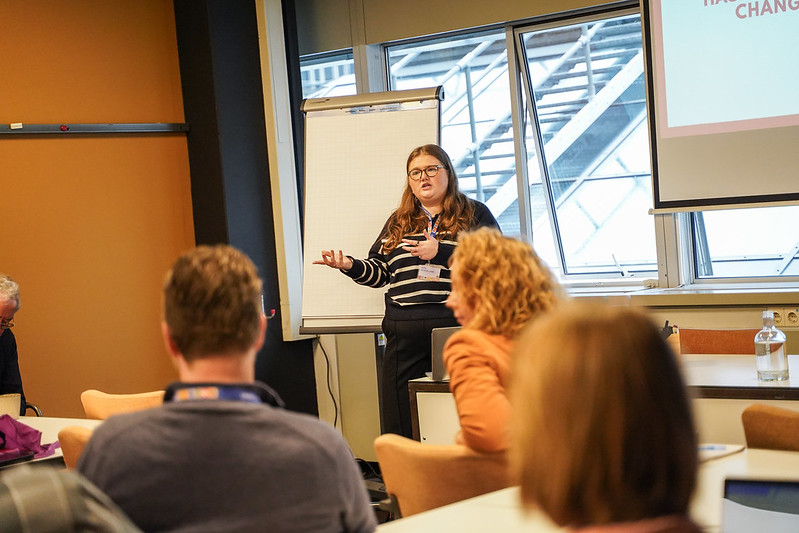
We might think that PKM is meant solely for the realm of work. But it does offer a lot of possibilities for harvesting knowledge in personal life too. Millennial Beth McClelland started to focus on this area during lockdown times.
PKM is for life, not just for productivity
@Beth McClelland doesn't just use PKM for work purposes. ‘Personal knowledge management is a life practice,’ she emphasizes. She publishes about PKM on pkmbeth.com.
‘PKMBeth.com is a place for me just to explore these ideas that I didn't see being represented in 2020 when I first started looking into PKM,’ McClelland explains her angle. At the time, she saw PKM being used primarily for productivity purposes. ‘Absolutely, PKM can help you be more productive. But why can't PKM work outside of your productive life, too?’
Good point, where else can we use PKM other than in the workplace? McClelland: ’We move into our new house next week. I planned everything in Capacities, which is a note-taking app. It's made me feel a lot more comfortable about the whole situation. Then I got so excited. I started planning Christmas, because I'm hosting my family. I've put that in Capacities too. It's working excellently. Similarly, I make silly little lists about everything. My brain's a very busy place. And sometimes I want to put that somewhere. So for me, PKM has evolved from just work into a whole life practice. I now have tools and ideas and systems that can help me externalize a very messy and very loud brain into a really joyful system. And that is what I'm now calling, thanks to a good friend who wrote about this recently, PKM as a life practice.’
So, what else can we PKM use for? McClelland taps into the wisdom of the crowd and asks her audience a couple of questions.
What is one unconventional use of PKM in your life?
Many ideas are being shared. The purposes for which this audience uses PKM are numerous and inspiring.
- ‘I use it for role-playing games. I've got a whole feed here containing these games,’ Nicole van der Hoeven says.
- ‘I’m planning holidays. All of my holiday plans are there with what to see, where we were, the itinerary, the tickets,’ says someone else.
- ‘As a psychotherapist, after every session I need to get rid of the information. I keep notes for that.’
- ‘Mine isn't notes. It's pictures,’ Nora Ghaoui says. ‘I have probably 1,000 pictures on my phone of all different kinds of furniture, lamps, garden things that I've seen in shops for the last 10 years. And when we're trying to decorate our house, and we go to like five different shops, I can always go back to my phone. Remember that sofa?’
‘I don't think PKM should just be text,’ McClelland adds. ‘Text is obviously a huge part of it, but I think we're kind of limiting ourselves in that way.’
>> Read the full article on Beth McClelland’s session.
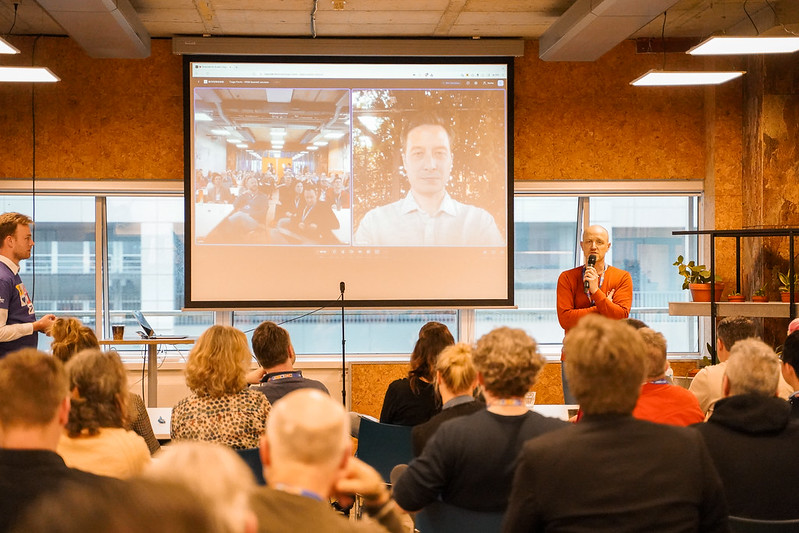
After the end of the first day packed with new insights, aha moments, and excitement about all the shown possibilities, the participants gathered for a Q&A with Tiago Forte, author of Building a Second Brain and The PARA Method. He’s working on a third book and publishes about PKM on his YouTube channel.
Building a Second Brain - A Q&A with Tiago Forte
Until 2016, Tiago Forte himself had never heard of PKM. ‘I came across an obscure Wikipedia article called Personal Knowledge Management, and I was like, “this describes exactly what I do”, but I had never heard anyone mention it. Fast forward to today, eight years later, and a lot of people are using it. So I feel like I started on the frontier, but then I kind of stayed where I was, and the frontier advanced and moved forward, both technologically with this new wave of apps and also in terms of artificial intelligence. But I'm still kind of where I was back then, at the fundamentals of personal knowledge management, and I'm still teaching and trying to get newcomers, to even just be aware of this and to adopt some of the simplest, really the simplest tool. Tools in many cases they already have and already use, like Apple Notes or Google Keep or Microsoft OneNote or ones like this. So I find my role has changed from daring frontiersman to almost like the wizened old guy of the space that has been around a long time. It's very strange. But I think what that sort of identity has led me to is to just push these ideas to more and more mainstream forums.
I spend a lot of time these days thinking about the memetic potential. What words to use, what examples, what framings, what context to try to have this thing enter people's brains who are not otherwise predisposed to it, people who are not necessarily early adopters, not necessarily tech savvy, not necessarily in creative industries.’
‘My notes from years ago are better. The easier it gets to capture, the worse my notes get.’
Q: Since you have been working with your systems for so long, are there still areas that you experience friction? What are these challenges and how do you tackle them?
Forte: There’s always friction. If there was no bottleneck or no friction, then I would instantly just transcend into this enlightened being that has no limits. But you know what's funny? I actually, over time, increasingly see friction as good. In the past, it was harder to capture things. We have so many apps now dedicated to capturing from any source. But I actually find in many cases my notes from years ago are better because it was harder. The easier it gets to capture, the worse my notes get.
It's good in other ways, too. The highest realms of creativity are not the ones that are most frictionless. It's not just ease of production that defines creativity. A lot of creativity is what you learn through suffering, through pain or through mistakes or failures. Whether big failures on the scale of your life or down to little mechanical failures in your second brain system. I think I've really gotten to the point where friction is just teaching me something about myself, about my psychology. It's teaching me something about what technology wants.
I'm a big fan of that idea from Kevin Kelly that technology actually has a will, has desires. I have this kind of conspiracy theory that even information has desires. When you come across a piece of information, a piece of content, you can really ask yourself, what does this want? What does it want to become? What does it want to influence, to impact? I think Elizabeth Gilbert [author of Big Magic] developed this idea that you're just really a channel. You're just an antenna for some creative force or signal that is much bigger than you. Nature or God or the Universe or whatever you want to say, trying to reach you, is really oddly. You’d think that would be a disempowering idea, but I actually found it quite an empowering one. Friction is just a manifestation of that. It's just the Universe saying that something shouldn't be easy or shouldn't happen in the first place. It's really sometimes as simple as you should put your attention elsewhere. If something is hard, maybe that's just a signal that you should pivot and take a different path of less resistance.’
>> Read the full Q&A with Tiago Forte.
At the end of the first summit day, there are so many radiating faces at the small gathering for some drinks. ‘Honestly, I feel so at home. To be surrounded by people who are as interested in PKM as I am, or even more devoted’, smiles one of the participants. Two others are chatting and comparing their notes of today in different tools. ‘I can’t wait for tomorrow, to stay in the PKM bubble and to deep dive even more in tips & tricks and opinions!’
>>> Click here for an impression of the second summit day.
Report: @Cath Spiceminds and @Cathelijne Esser
Photo’s: @Jeroen Koster